From Noob To “The OG of 3D Scanning“
I was 51 when I first 3D scanned an object. The love (and “Wow!”) was there from the start. It was made even more impressive by the fact that I had made an umbrella like dome of photographs over the object with my phone to capture enough angles, uploaded it, then an hour later it was sent back in 3D.
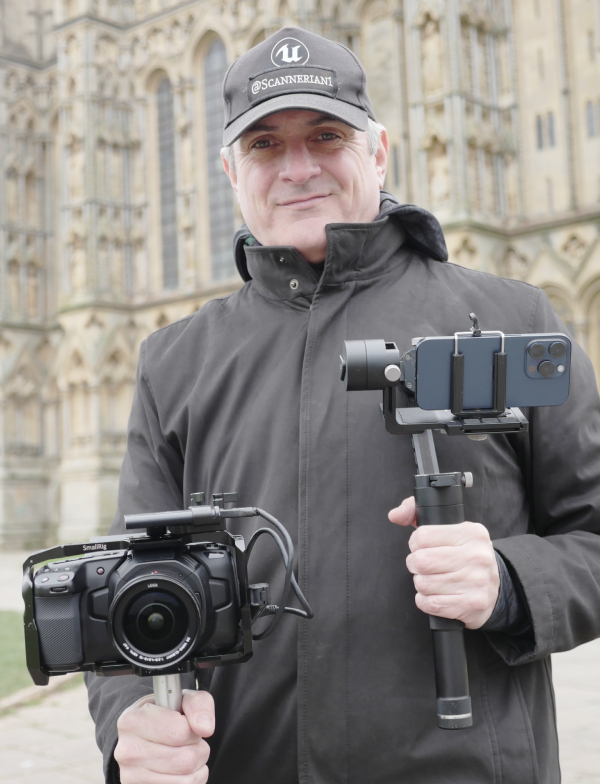
My career in media before 3D scanning frequently involved electronics, computers, video and photography. The electronics and computing knowledge I left school and higher education with in the mid 80’s. The love for cameras was my hobby from the same time. Growing up with film then digital cameras, I seemed to always be one format behind. I started learning video on a clunky VHS, then a more portable Hi 8, then a compact mini-DV with tape capture and later DVD discs. The fingernail sized SD card replaced these systems and made editing smoother and quicker (thankfully). Today, I use a pocket cinema camera with an SSD drive and professional photography cameras. I’ve also been editing video and photography since the mid 90’s and enjoy producing professional videos for all kinds of events and campaigns.
Holograms
I used to joke about holograms being the next thing to replace video, but never actually believed I’d see it in this lifetime. Then, in 2012, the deceased rapper, TuPac appeared on stage with Snoop Dogg and DRE at a gig in the U.S called Coachella.
With the ability to create a video of a 3D object you’ve scanned and film it again in augmented reality you can make 4D volumetric video. This is a simple type of holographic experience and looks great on my Head Mounted Display (HMD) in Virtual Reality or AR glasses, (which are set to replace our phones so we can free up our hands).
Astounding Architecture
Since my teenage years, I’ve always been in awe of the buildings of yesteryear and like most people who visit them appreciate the meticulous details that are in them. It didn’t take me long to begin scanning the local ones to me, then sharing my results on social platforms daily.
Roll on a few years later and after scanning just about anything I could in my area of England, companies like Shutterstock and Pokemon Go’s creators (among a few) began asking me for professional quality scans and tutorial videos and this has became something of a career. Today, I’ve featured on a several podcasts and written a few blog articles on my 3D scanning tips and tricks too.
Michael Rubloff who runs one of the leading Blogs in the world of 3D scanning paid me a nice compliment by calling me the “OG of the 3D scanning world”. In the same interview, I was also described as world leading expert by another leading expert on 3D scans Mr NeRF. Of course, I’m flattered, but at the end of the day I only scanned things that were made by others. It’s the same as taking a short video (imho). I came a long way in 5 years with my phone and a few 3d scanning apps that I beta tested for developers. Without them nothing would be possible in the 3D we have today.
Radiance Fields Interview with me: “the OG of 3D scanning world”.
Emerging Then, Established Now
At the time of writing, I feel the once emerging technologies of vr/ar and 3D scanning are here to stay. New apps & platforms are arriving daily for 3D scanning enthusiasts and professionals. Also, new technologies that make large area scans in minutes are digitising the real world into a 3D Metaverse, are common place in 2025.
The interactivity between our virtual and augmented worlds using hand, feet, tongue, eye tracking controllers is labelled as extended reality (XR) and that’s going to keep growing exponentially from here.
Artificial Aptitude
AI is at the helm of it all as it has the ability to create 3D worlds from simple text prompts to rendering 3D models by working out the path and angle of each light ray falling on the scanned object. This is a type of ray marching that takes today’s binary seconds to render, but took days to compute less than 3 years ago.
I recently used my VR headset to scan my front room and to see it, you would think you were in it. That’s how good a 5 minute scan using Gaussian splats is these days. Mapping systems are already changing over from 360 images to immaculate 3D with the ability to move in it with six degrees of freedom (6DOF). That makes myself and lot of others in this industry excited as we move forward with capturing the world we live in 3D.
 Scannerian